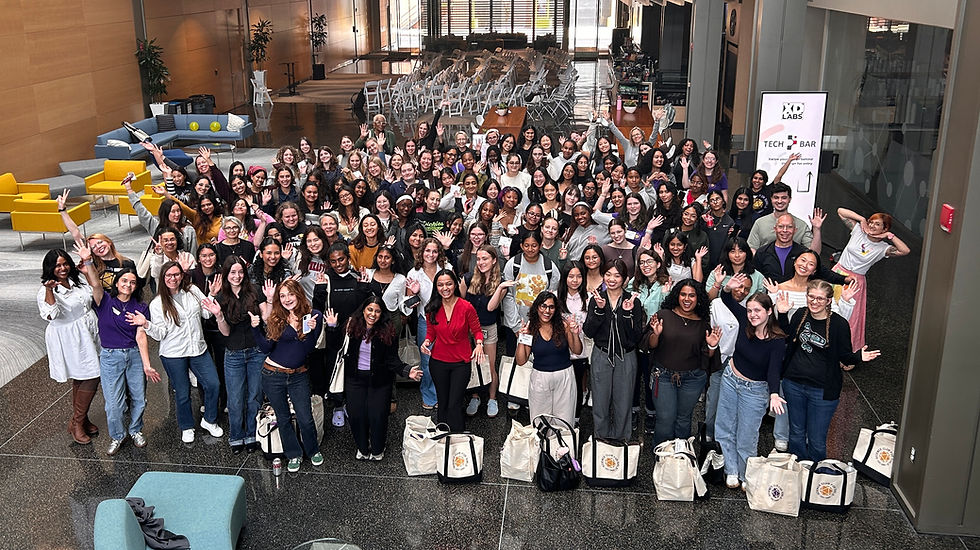
Highlights from SCFG's Coding Club 2026!
Updated: Mar 17

This February, 26 middle school girls and gender-expansive youth joined us for Coding Club. Over the course of the week, they learned the foundations of HTML and CSS, built their own websites, met women working in STEM, and pushed themselves in ways that were both technical and personal. Every year of Coding Club feels a little different. This year stood out for how collaborative the group became.
We began with the big picture before diving into code. We talked about what computer science actually is and where it shows up in daily life. We also shared stories about women who shaped computing history, including the women who worked as “human computers” during NASA’s early space program. For many of the participants, that history was new. It helped frame the week with an important message: women have always been part of this field.

Once laptops were opened and CodePen (an online coding platform for building and testing HTML, CSS, and JavaScript) was up on the screen, the energy shifted. The first day of coding was full of small but meaningful wins, whether it was a working link or an image uploading correctly. There were also plenty of mistakes, which quickly became part of the learning process. When something did not display as expected, it gave us an opportunity to slow down and figure out why. After learning the basics of HTML and CSS, the participants began personalizing their sites by exploring features they were interested in adding. They worked together to research how to implement these elements and tested different approaches as they built. Rather than providing step-by-step instructions for each feature, we encouraged collaboration, research, and experimentation. The room often looked like small groups leaning over screens, comparing code and troubleshooting together. It was similar to how real developers solve problems in the workspace.

One of the biggest shifts this year was how often the girls stepped into teaching roles. A few of the older, returning participants who had prior coding experience volunteered to explain what they had done to the entire group. They stood at the front with the microphone and walked everyone through their code, explaining how a CSS property worked or why something wasn’t displaying properly. You could see how proud they felt being called upon teach. Holding the microphone, they spoke clearly and confidently, and their peers were fully tuned in. The room felt different in those moments. Instead of the SCFG Program Team leading every explanation, the girls were leading each other. The learning did not just come from Program Managers. It came from the youth, and they rose to the occasion.

Midweek, we connected coding to careers during our Scientist Meet and Greet. The girls prepared thoughtful questions and rotated through interactive sessions with four incredible women in STEM: Africa Martin, Process Engineer; Shruti Suresh, Business Intelligence and Data Analyst; Eden Allen, Healthcare Data Analyst; and Sarah Widrow, Process Improvement Engineer. They analyzed Spotify data using Python, participated in a mock drug trial, and ran a simulation focused on improving hospital wait times. These activities helped translate job titles into something tangible. Instead of just hearing what someone does, the girls experienced a version of it themselves.
At the end of the rotations, the Mentors joined together for a short panel where participants had the chance to ask questions about college, career paths, and what their day-to-day work really looks like. The questions were thoughtful and honest, and the conversation made these careers feel even more accessible and real.

Thanks to a grant from IF/THEN®, an initiative of Lyda Hill Philanthropies, this year we also added a Gallery Walk to Coding Club. Posters featuring women in computer science, data science, and related fields were placed around the room. Participants moved through the space, reading short biographies, and then used reflection worksheets to imagine themselves in similar careers. Many of the girls were chatty and open about what interested them. Some talked about becoming data scientists. Others were drawn to engineering or research. The conversations were thoughtful and forward-looking.


The week ended with a showcase. Each participant presented their website or digital vision board to the group. Some spoke confidently about advanced features they had figured out on their own. Others challenged themselves to present even if public speaking felt uncomfortable. The room was filled with cheering after every presentation. One participant decided at the last minute that she wanted to present after all, and the support she received made it clear that this was a space where taking that kind of risk felt safe.
By the end of the week, each participant had built a functional, personalized website. But what stood out most to us was the ownership they displayed. They researched solutions instead of waiting for answers. They explained concepts to one another. They asked bigger questions about where coding could take them.
Coding Club 2026 was not solely about learning web coding. It was about collaboration, leadership, and seeing what happens when girls and gender-expansive youth are given the space to figure things out together.
Thank you to the funders who supported the 2026 Coding Club, including the Cabot Family Charitable Trust and IF/THEN® (an initiative of Lyda Hill Philanthropies).